

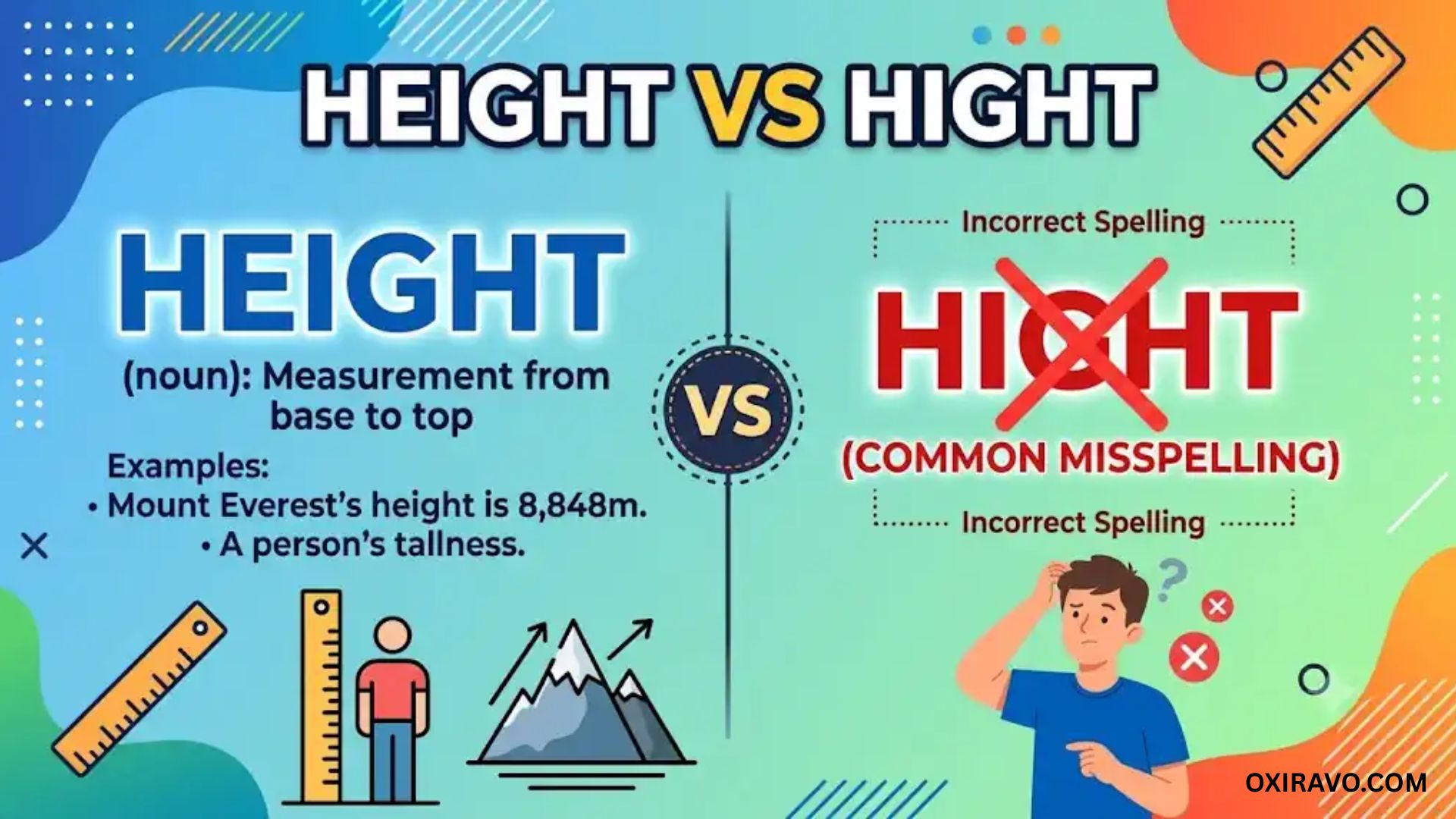
If you’ve ever paused mid-sentence wondering whether to type “height” or “hight,” you’re not alone. The height vs hight confusion pops up more often than you’d think, especially among people learning English or writing quickly without a second glance at spell-check. So let’s settle the height vs hight meaning question once and for all, and figure out exactly when (if ever) you’d use the second spelling.
What Do Height and Hight Actually Mean?
Height Definition
Height refers to the measurement of something from base to top. It’s the word you reach for when talking about a building, a mountain, a doorway, or a person. According to Merriam-Webster, height means “the quality of being high,” “the highest part,” or “the distance from the bottom to the top of something standing upright.” It’s a workhorse noun, showing up in science, sports, fashion, real estate, and casual conversation alike.
Hight Definition
Hight, on the other hand, is a fossil of the language. It’s an archaic word that once meant “called” or “named.” You’d find it in old poetry or medieval texts, as in “a knight hight Lancelot,” meaning a knight named Lancelot. Nobody uses it that way anymore outside of historical fiction or academic study.
Height vs Hight: The Core Difference
Here’s the difference between height and hight in plain terms: they’re not variant spellings of the same word at all. They’re two entirely separate words that happen to look alike. So when someone asks, is it height or hight, the honest answer depends on what they mean. If you’re talking about how tall something is, you want height. If you’re somehow writing dialogue set in the 1400s, “hight” might apply, but even then, most modern readers won’t recognize it.
For everyday writing, the correct spelling of height is, unsurprisingly, h-e-i-g-h-t. That’s the version taught in schools, printed in dictionaries, and expected in every professional or academic context. Modern English spelling simply doesn’t have room for “hight” as a synonym.
Why Is Height Spelled With “ei”?
English spelling can feel like it’s making things up as it goes, and in a way, it is. The “ei” in height traces back to Old English and Germanic roots, where the word evolved through several forms before settling into its current shape. Unlike most “i before e” words, height breaks the classic rule kids learn in grammar school. That’s just one of many quirks tucked into the broader spelling rules English speakers wrestle with daily. The safest bet is to memorize height as an exception rather than trying to force it into a pattern.
Is Hight a Real Word in English?
Technically, yes. Hight is a real, documented word, just not one you’ll hear at the grocery store. What does hight mean in old English? It functioned as the past tense or past participle of an old verb meaning “to call” or “to name.” A character in an old ballad might be “hight” something, meaning they were called or named that. It’s one of several archaic English words that survive mostly in literature, crossword puzzles, and etymology discussions.
Can I Use Hight in Formal Writing?
Short answer: no, skip it. Unless you’re deliberately recreating archaic speech for a novel, poem, or historical piece, “hight” will confuse your reader rather than impress them. Here’s how that mix-up might look in a real-world scenario.
Email Example (Incorrect Usage):
Subject: Application Update
Hi Marcus,
Thanks for submitting your application. Before we proceed, could you confirm your hight and weight for the uniform sizing chart?
Best, Priya
That sentence should read “height and weight.” A recruiter or HR coordinator reading “hight” might assume it’s a typo, or worse, question the sender’s attention to detail. In professional communication, sticking with height protects your credibility.
Height, High, and Tall: Untangling the Trio
Tall vs High vs Height
People often lump height, high, and tall together, but each one plays a different grammatical role. Here’s the difference between height, high, and tall, broken down simply:
- Height is a noun. “The height of the fence is six feet.”
- High is an adjective (or adverb). “That’s a high fence.”
- Tall is also an adjective, usually reserved for things that are notably narrow and vertical, like people, trees, or buildings. “He’s a tall man.”
So what is the difference between height and high? Height names the measurement itself, while high describes something that possesses a lot of that measurement. You wouldn’t say “a height fence”; you’d say “a high fence” with a certain height.
Common Uses of Height in Everyday English
Vertical Distance and Measurement
At its core, height describes vertical distance, the space between the lowest and highest points of an object. When engineers or architects talk about vertical measurement, they’re almost always talking about height, whether it’s a ceiling, a bridge support, or a skyscraper.
Height Above Sea Level and Elevation
Geography loves this word too. Height above sea level tells you how far up a location sits compared to the ocean’s surface, which is why mountain guides and pilots talk constantly about elevation. Everest’s highest point (its peak) sits roughly 29,032 feet above sea level, a figure you’ll find on nearly any geography reference site, including National Geographic.
Stature and Physical Description
When describing a person, height often gets swapped for the word stature, especially in more formal or literary writing. “A man of impressive stature” sounds a touch more elegant than “a tall guy.” This matters for what is the correct spelling for a person’s height on forms too; medical intake sheets, passport applications, and driver’s license renewals all ask for height, spelled the standard way, no exceptions.
Text Message Example:
Hey Sofia, quick question for the doctor’s office form, what’s your height and weight again? They want it in inches and pounds.
Height Requirements
Amusement parks, military enlistment, and certain jobs all come with a height requirement. A sign at a roller coaster entrance might read: “Riders must meet a minimum height requirement of 48 inches.” Get that spelling wrong on official signage, and you’ll look unprofessional fast.
Fear of Heights
The fear of heights, known clinically as acrophobia, is one of the most common phobias worldwide. Someone might casually mention, “I can’t do the observation deck, I’ve got a serious fear of heights,” and that sentence only works with the correct spelling.
Figurative Height
Height isn’t only literal. It carries a height figurative meaning too, describing peak intensity or extremity. Think of phrases like “the height of fashion” or being caught somewhere embarrassing “at the height of a crisis.” A solid height synonym in these figurative cases might be “peak,” “pinnacle,” or “zenith,” depending on tone.
Common Mistakes with the Word Height
Among the more frequent English spelling mistakes, height ranks surprisingly high (pun intended). Writers often add an extra letter, drop the “g,” or, as we’ve covered, confuse it with “hight.” These aren’t just cosmetic issues; they’re grammar mistakes that can undercut an otherwise polished piece of writing. Height joins a long list of commonly confused words in English, right alongside “affect/effect” and “their/there/they’re.”
How to Remember the Correct Spelling of Height
A simple trick: think of the phrase “height has eight letters minus a few,” or picture the word “eight” hiding inside “h-EIGHT” (well, almost). Some people find it easier to just remember that height rhymes with “kite,” and both have that “igh” sound tucked in the middle. Repetition helps too. Write the word a few times in a sentence you’ll actually use, and it tends to stick.
Height vs Hight: Quick Comparison
| Feature | Height | Hight |
|---|---|---|
| Part of speech | Noun | Archaic verb form |
| Meaning | Vertical measurement | Called or named |
| Modern usage | Common, everyday | Essentially obsolete |
| Formal writing | Correct choice | Avoid |
| Example | “The height of the wall is 10 feet.” | “The tower hight Camelot.” |
This height vs hight quick comparison makes the choice obvious for anyone still on the fence.
Height vs Hight in 2025 and 2026: Does Usage Change?
Language shifts slowly, and even looking at height vs hight 2025 2026 usage trends, nothing suggests “hight” is making a comeback. Search data and style guides both confirm that height remains the standard, while hight stays parked firmly in historical and literary corners. If anything, digital spell-checkers have made the mix-up rarer, since most software flags “hight” as questionable outside proper nouns or names.
Rules for Using Height Correctly in Writing
A few quick rules for using height correctly in writing:
- Use height as a noun for measurements, never as a verb.
- Pair it naturally with numbers and units: “a height of five feet ten inches.”
- Avoid archaic substitutes like “hight” unless writing period pieces.
- Double-check forms, resumes, and official documents, since typos here look sloppy.
- Remember the “ei” spelling, since spell-check won’t always catch a real word used incorrectly.
Height vs Hight: Examples in Sentences
Looking at height vs hight examples in sentences side by side clears up any remaining doubt.
- Correct: “The height of the bookshelf matches the doorway exactly.”
- Incorrect: “The hight of the bookshelf matches the doorway exactly.”
- Archaic (acceptable only in old-style writing): “A maiden hight Rosalind wandered the forest.”
Job Posting Example:
Warehouse Associate Position — Requirements Applicants must meet the following criteria: ability to lift 50 lbs, minimum height of 5’2″, and availability for weekend shifts. Contact: hiring@brightlogistics.com, Attn: Daniel Reyes
Notice how naturally height fits into practical, real-world contexts like job listings, medical forms, and travel documentation. That’s because it’s doing exactly what a modern noun should: describing something clearly, without unnecessary flourish.
Frequently Asked Questions
Is Height or Hight the Correct Spelling?
Height is correct for describing measurement. Hight is a separate, outdated word meaning “named” or “called.”
What Is the Archaic Meaning of Hight?
It meant someone or something was called by a particular name, often seen in old English literature and folklore.
What Is the Difference Between Height and High?
Height is a noun describing measurement; high is an adjective describing the quality of having a large measurement.
Understanding this distinction saves you from an awkward typo showing up in an email, a resume, or a school essay. Height does the heavy lifting in modern English, while hight quietly rests in the past, waiting for the occasional poem or historical novel to bring it back to life.
