

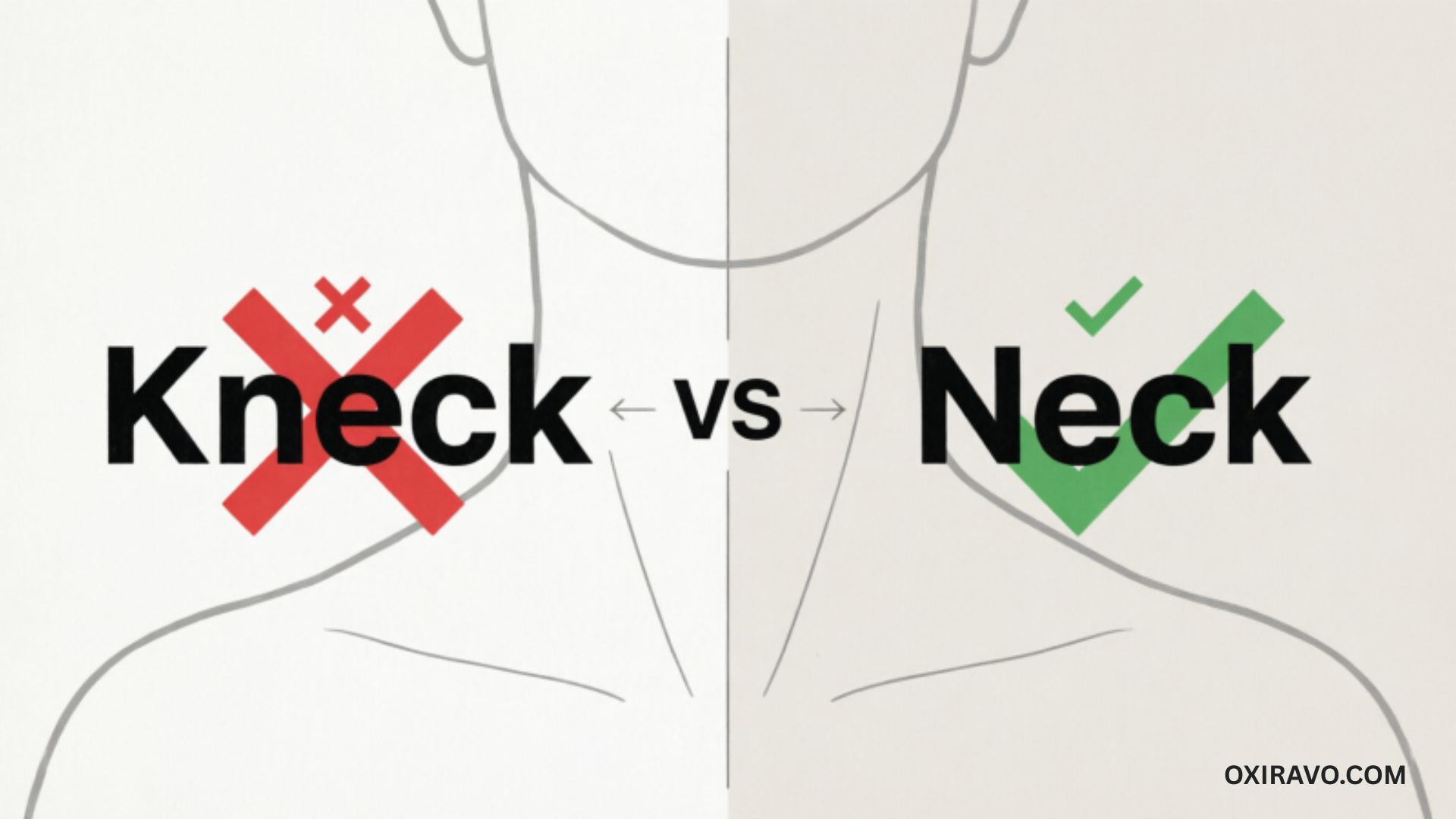
You’re typing an email, you get to a word you’ve spelled a thousand times, and suddenly it looks… wrong. Is it “neck” or “kneck”? You stare at the screen. Your fingers hover. This happens more often than you’d think, and there’s a good reason for it. Let’s settle the Kneck vs Neck question once and for all, and along the way, we’ll dig into why English spelling trips up even sharp, careful writers.
The Short Answer
There’s only one correct spelling, and it’s neck. “Kneck” isn’t a word. It never was. You won’t find it in Merriam-Webster, Oxford, Cambridge, or any dictionary with any shred of dictionary validity. If you’ve been writing “kneck” your whole life and just found this out, don’t feel bad. You’re in good company, and by the end of this article, you’ll never make the mistake again.
Is Kneck a Real Word?
Let’s address this head-on, since it’s probably what brought you here in the first place: is kneck a real word in English? No. Full stop. It doesn’t appear in any standard dictionary, it has no accepted definition, and no style guide recognizes it as an alternate spelling. If you search for it, you’ll mostly find results about the mistake, not results using the word correctly, because there is no correct way to use it.
So why does this question even come up? Because the mistake is common enough that people start to doubt themselves. When enough people make the same spelling mistake, it starts to feel almost legitimate, like maybe there’s a rule you missed in third grade. There isn’t. “Kneck” is simply a kneck spelling mistake, plain and simple, and understanding why it happens is more interesting than you’d expect.
Why Do People Write Kneck Instead of Neck?
Here’s the real question worth digging into: why do people write kneck instead of neck? The answer lies in a pattern-recognition habit built into how our brains handle language.
English has a small but memorable group of words where a silent K sits at the front, doing absolutely nothing except confusing new writers. Think of:
- Knee
- Knife
- Knight
- Knot
- Know
- Knuckle
Every one of these words starts with “kn,” and in every one, the K stays completely silent. You say “nee,” not “kuh-nee.” You say “nife,” not “kuh-nife.” Once your brain absorbs this pattern, it starts applying it more broadly than it should, even to words where it doesn’t belong. That’s the whole story behind the confusion. It’s not laziness or carelessness. It’s your brain doing what brains do: finding patterns and reusing them, sometimes in the wrong place.
Correct Spelling of Neck (And Why It Has No Silent K)
The correct spelling of neck body part is n-e-c-k. Four letters, no silent anything. It comes from the Old English word “hnecca,” which referred to the back of the neck specifically. Over centuries, the “h” dropped away and the spelling settled into the version we use today. Unlike “knee” or “knife,” which trace back to Old English words that genuinely began with a “kn” sound (pronounced, not silent, way back then), “neck” never had that beginning. That’s really the heart of the matter: why does neck have no silent K? Because it was never part of that particular word family to start with. The silent-K words and “neck” simply evolved along different paths, even though they now sit right next to each other in meaning and in your mental dictionary of body parts.
This is a great example of what linguists call overgeneralization of spelling rules. You learn a pattern that works for a handful of words, and your brain assumes it must work for a related word too. It’s the same mental shortcut that makes kids say “goed” instead of “went,” because most English verbs add “-ed” for the past tense. The logic makes sense. It’s just wrong here.
Neck Meaning and Word Origin and Pronunciation
Let’s cover the basics, since a little word origin and pronunciation context makes the spelling stick better in memory.
The neck meaning, in its most literal sense, refers to the body part connecting head and shoulders. It’s the narrow section of the body that lets your head turn, tilt, and nod, connecting your skull to your torso and housing your throat, spine, and a small forest of muscles and nerves.
Pronunciation-wise, it’s straightforward: rhymes with “check,” “deck,” and “peck.” One syllable, hard “n” sound at the start, hard “k” sound at the end. There’s no trick to saying it. The trouble only shows up when people try to write it, not speak it, which brings us to an important point.
A Sound-Based Spelling Error
The “kneck” mistake is a textbook sound-based spelling error. English is full of words where letters don’t match the sounds you’d expect, and after a while, your brain starts to trust patterns over rules. Since “kn” words sound exactly like plain “n” words when spoken aloud, your ear can’t tell you which spelling is right. Only memory and practice can. This is precisely why spell check accuracy matters so much for catching these kinds of errors, since your own ear will happily lead you astray.
Common Phrases Using the Word Neck
One of the best ways to lock in the correct spelling is to see the word in action, in phrases you’ll actually use. Here are some of the most common phrases using the word neck, along with what they mean:
- Neck and neck – Describes a close race or competition, where two people or things are running so evenly matched you can’t tell who’s ahead.
- Pain in the neck – An annoying person, task, or situation. “That printer is such a pain in the neck.”
- Breakneck speed – Moving dangerously or recklessly fast.
- Bottleneck – A point of congestion or delay, borrowed from the narrow neck of a bottle that slows the flow of liquid.
- Neck of land – A narrow strip of land connecting two larger areas, often used in geography.
- Stick your neck out – To take a risk or make yourself vulnerable by speaking up or acting boldly.
- Up to your neck in something – Overwhelmed or deeply involved in a task or problem.
Notice something? Every single one of these idioms uses neck, never “kneck.” If you’ve ever typed “breakneck” or “bottleneck” correctly without thinking twice, that’s actually good news. It means the correct spelling already lives somewhere in your muscle memory. You just need to trust it when the word stands alone too.
Scenario Examples: Neck in Real-World Writing
Seeing the word used correctly across different types of writing helps cement it. Below are a few realistic scenarios where “neck” shows up, and how a careful writer would handle it.
Scenario 1: A Casual Email to a Friend
Subject: Ugh, my neck is killing me
Hey Marcus,
Remind me never to sleep on the couch again. I woke up this morning and could barely turn my head, my neck is so stiff. I think I’m going to book a massage this weekend if I can find an opening. Anyway, are we still on for Friday? Let me know if the bottleneck on the highway construction is going to mess with your commute.
Talk soon, Priya
Scenario 2: A Professional Email to a Colleague
Subject: Project timeline update
Hi Daniel,
Just a heads-up that we’re running neck and neck with the competitor’s product launch, so I’d like to move our review meeting up by two days if possible. I know that puts us in a bit of a bottleneck with the design team’s schedule, but I think it’s worth the trade-off to stay competitive.
Let me know your thoughts.
Best, Selena
Scenario 3: A Medical Context
Subject: Follow-up appointment notes
Dear Mr. Alvarez,
Following your visit yesterday, Dr. Whitfield recommends physical therapy to address the tension in your neck and upper shoulders. Please schedule your first session within the next two weeks, and avoid any activity that puts strain on the affected area in the meantime.
Kind regards, Front Desk, Riverside Health Clinic
Scenario 4: A Travel Blog Post
Driving along the coast, we reached a stunning neck of land where the ocean pressed in on both sides. The road narrowed to a single lane, and locals warned us not to take it at breakneck speed, since the curves hug the cliffside without much warning.
Scenario 5: A Text Message Between Coworkers
Hey, quick one — is the report bottlenecked on your end or mine? Don’t want to be a pain in the neck about it, just trying to plan my afternoon.
Across every one of these, formal or casual, medical or conversational, the spelling never changes. That consistency is exactly what makes “neck” easy to trust once it clicks.
Correct Usage of Neck in a Sentence
If you want a few clean, simple examples to keep in your back pocket, here’s the correct usage of neck in a sentence:
- She wrapped a scarf around her neck to block the wind.
- The giraffe’s long neck lets it reach leaves other animals can’t.
- He felt a sharp pain in his neck after the long flight.
- Traffic slowed to a crawl at the bottleneck near the bridge.
- The two runners finished neck and neck, separated by a fraction of a second.
Simple, right? Once you see it enough times, the “kn” version starts to look genuinely strange, the way any misspelled word does once your eye gets trained to catch it.
Difference Between Knee, Knife, and Neck Spelling
Let’s put this side by side, because seeing the difference between knee, knife, and neck spelling laid out plainly tends to answer any lingering doubts.
| Word | Starts With | Silent Letter? | Category |
|---|---|---|---|
| Knee | Kn- | Yes, silent K | Body part |
| Knife | Kn- | Yes, silent K | Object/tool |
| Knuckle | Kn- | Yes, silent K | Body part |
| Neck | N- | No silent letter | Body part |
The pattern breaks right where you’d least expect it. Two body parts, “knee” and “neck,” sit right next to each other on the human body and right next to each other in conversation, yet they follow completely different spelling rules. That inconsistency isn’t a flaw in your understanding. It’s a genuine quirk of English, and honestly, quirks like this are half the reason English has a reputation for being tricky to master.
Kneck vs Neck: Quick Decision Guide
Need a fast mental checklist next time you freeze mid-sentence? Here’s your kneck vs neck quick decision guide:
- Does the word describe the body part connecting your head and shoulders? Spell it “neck.” Always.
- Does it start with a sound like “kuh-nee” or “kuh-nife”? Then it might genuinely belong to the silent-K family (knee, knife, knot, know). Neck doesn’t belong there.
- When in doubt, say the idiom out loud. “Breakneck,” “bottleneck,” “neck and neck.” None of them ever take a K.
- If your spell checker underlines it, trust it. This one’s a rare case where the squiggly red line is right every single time.
How to Avoid Spelling Neck as Kneck
If this mistake has snuck into your writing before, here’s practical advice on how to avoid spelling neck as kneck going forward:
Build a Mental Anchor
Pick one phrase you already spell correctly without thinking, like “bottleneck” or “breakneck speed,” and use it as your anchor. Whenever you type “neck” in isolation, mentally connect it back to that phrase. If “bottleneck” doesn’t have a K in the middle, “neck” doesn’t need one either.
Slow Down on Autopilot Typing
Most common typing mistakes happen when you’re moving fast and not really looking at the screen. Slowing down for a half-second on tricky words gives your brain a chance to catch errors before they happen, rather than after.
Read Your Writing Out Loud
This sounds almost too simple to work, but it does. Reading a sentence aloud forces your eyes to actually track each word instead of skimming past familiar shapes. Misspellings tend to jump out more when you’re reading for sound and meaning together, rather than just scanning.
Lean on Spell Check, But Don’t Rely on It Blindly
Spell check accuracy has improved a lot over the years, and most modern tools will flag “kneck” instantly. Still, it’s worth understanding why the word is wrong rather than just trusting the red squiggly line, since that understanding sticks with you even when you’re typing somewhere without spell check, like a quick text or a handwritten note.
Grammar and Vocabulary Tips for English Language Learners
For English language learners, this particular mix-up offers a useful lesson about the language as a whole. English didn’t develop as one clean, consistent system. It absorbed influences from Old English, Norse, French, Latin, and Greek, and each source brought its own spelling habits along for the ride. That’s exactly why you’ll find inconsistent patterns like the silent K pattern (knee, knife) existing right beside words like “neck” that skipped that pattern entirely.
A few broader grammar and vocabulary tips worth keeping in mind:
- Group words by origin when you can, not just by sound. Words that sound alike don’t always share a spelling history.
- Keep a running list of words you personally tend to misspell. Everyone has a handful of “trap” words, and neck might be yours, or it might be something else entirely, like “definitely” or “separate.”
- Read widely. Exposure to correctly spelled words in books, articles, and even social media posts (written by careful writers) builds familiarity faster than memorizing rules ever will.
- Don’t be embarrassed by mistakes like this one. Even native speakers mix up commonly misspelled words on a regular basis. It’s part of learning a language that’s absorbed influences from a dozen directions over a thousand years.
Body Part Terminology and Why Precision Matters
In fields like healthcare, fitness, and anatomy, body part terminology needs to be exact. A typo in a medical chart, a fitness article, or an anatomy textbook can create real confusion, especially when the reader is trying to follow instructions about stretching, injury, or treatment. Writing “kneck” in a professional document doesn’t just look sloppy, it can undermine the reader’s confidence in the accuracy of everything else you’ve written. Writing accuracy matters most exactly in these situations, where a small slip can carry outsized consequences.
Is Kneck Ever Correct in Writing?
Let’s close the loop on one more angle: is kneck ever correct in writing, under any circumstance at all? Not in standard English, no. It’s not a regional variant, it’s not an older or archaic spelling that fell out of use, and it’s not accepted in any formal or informal context. Unlike words that have multiple valid spellings depending on region, like “color” versus “colour,” neck has exactly one accepted form everywhere English is spoken and written, from London to Los Angeles to Lagos.
Wrapping It Up
So, to bring the whole Kneck vs Neck difference explained back to one clear takeaway: there’s no debate here, no gray area, no regional exception. “Neck” is correct. “Kneck” is a mistake, and now you know exactly why it happens, thanks to the silent-K pattern borrowed from words like knee and knife, and exactly how to avoid it going forward.
English spelling errors like this one aren’t a sign that you’re bad at writing. They’re a sign that English is a genuinely inconsistent language, stitched together from centuries of borrowed words and shifting pronunciation. The next time you write an email, a text, or a blog post and your fingers hesitate over “neck,” you’ll know exactly what to do. Skip the K, trust the pattern you’ve now got locked in, and move on with confidence.
