

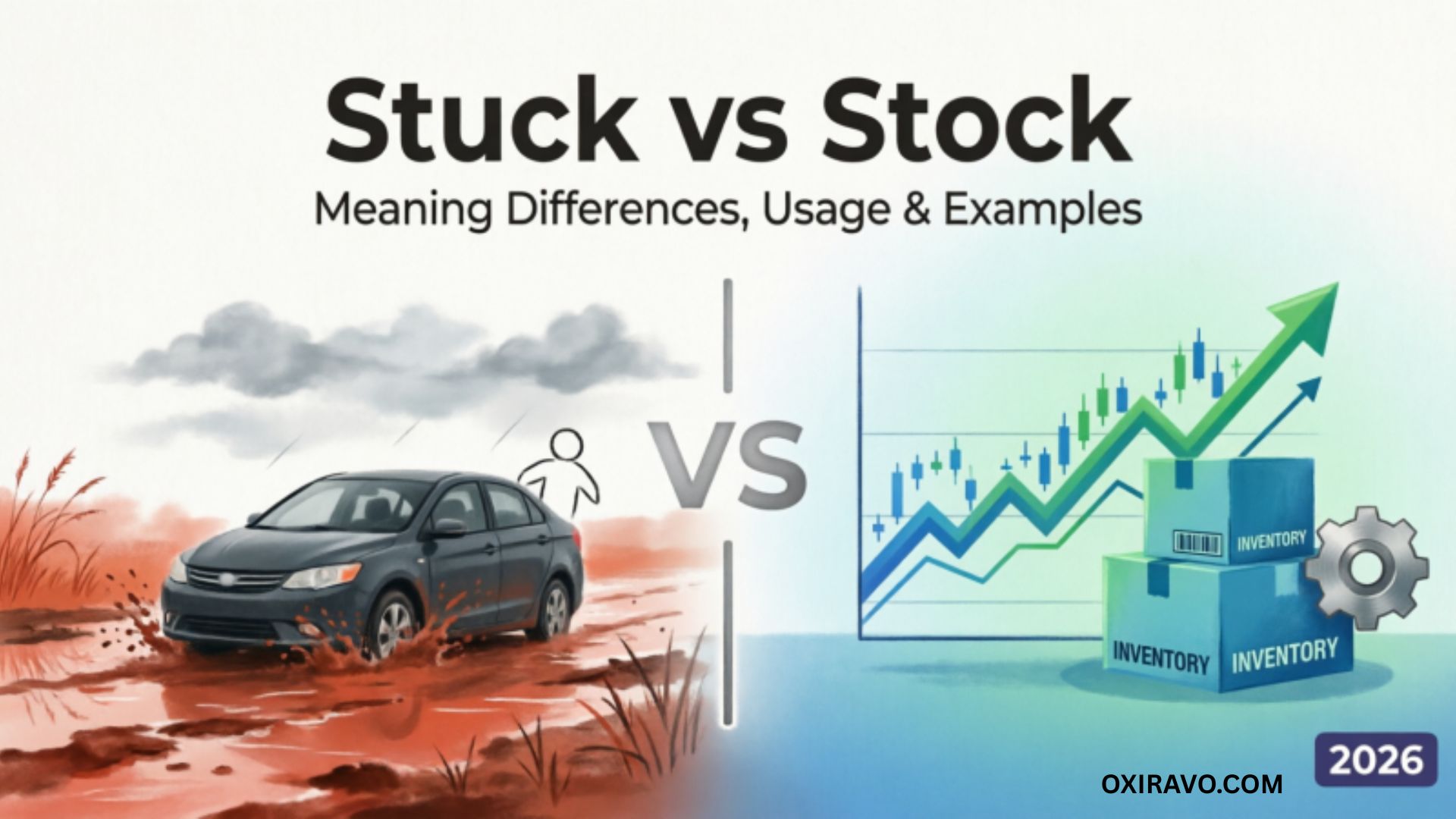
Choosing the right word can completely change the meaning of a sentence. That is exactly why Stuck vs Stock continues to confuse English learners, students, and even native speakers. Although these two words differ by only one letter, they have entirely different meanings and belong in different situations.
Imagine sending a message that says, “I’m stock in traffic.” Most readers will understand what you meant, but they will also notice the mistake immediately. The correct phrase is “I’m stuck in traffic,” because stuck describes a person or object that cannot move. By contrast, stock usually refers to products, inventory, or company ownership.
Throughout this guide, you’ll discover the difference between stuck and stock, learn the correct definitions, and explore practical examples you can use in everyday conversations. In addition, you’ll find grammar tips, comparison tables, and memorable tricks that make these commonly confused words much easier to remember.
Whether you’re improving your English vocabulary, polishing your English writing skills, or simply trying to avoid common grammar mistakes, this guide will help you choose the correct word with confidence.
Why Do People Confuse Stuck and Stock?
At first glance, Stuck vs. Stock doesn’t seem like a difficult comparison. After all, the words look similar. However, appearances can be misleading.
Both words contain almost the same letters. As a result, many people accidentally swap them while typing or speaking quickly. In addition, English learners often memorize vocabulary without seeing enough real-life examples. That habit makes confusing English words even harder to master.
Pronunciation also plays a role. Depending on someone’s accent, the vowel sounds may seem alike. Consequently, learners sometimes write one word when they actually mean the other.
Fortunately, you don’t need to memorize dozens of grammar rules. Once you understand the purpose of each word, the choice becomes much easier.
What Does Stuck Mean?
Before comparing the two words, it’s important to understand the stuck meaning.
Simply put, stuck describes a situation where someone or something is unable to move, escape, or continue. Sometimes the problem is physical. In other cases, it can be emotional or mental.
Stuck Definition
The stuck definition is:
Unable to move, unable to escape, or unable to progress.
Many dictionaries also connect stuck with the idea of being trapped. Because of that, learners often associate it with trapped meaning, which provides an easy way to remember the word.
Stuck Meaning in English
In everyday conversations, the stuck meaning in English appears in many situations.
For example, someone can be:
- stuck in traffic
- stuck in mud
- stuck on a problem
- stuck in an elevator
- stuck at the airport
- stuck in a difficult situation
Each example shares one important idea. Something prevents progress.
Scenario Example: Stuck in Everyday Life
Picture yourself driving to work on Monday morning. Everything goes smoothly until an accident blocks every lane. Minutes pass, yet no cars move.
You send your manager a quick text:
“I’m stuck in traffic. I’ll be there as soon as I can.”
That sentence sounds natural because your car is unable to move.
Now imagine you’re hiking after heavy rain. Halfway through the trail, your boots sink deep into wet ground.
You laugh and tell your friend,
“I’m stuck in mud. Give me a hand!”
Once again, stuck fits perfectly because you’re trapped.
Here’s one more example.
After working on a difficult math assignment for an hour, you still can’t solve the final question. Frustrated, you say,
“I’m stuck on a problem.”
This time, you aren’t physically trapped. Instead, you’re unable to progress toward a solution.
When to Use Stuck
Many learners ask when to use stuck, and the answer is surprisingly simple.
Choose stuck whenever someone or something cannot move forward, either literally or figuratively.
Use stuck in sentences like these:
- We got stuck in traffic after the concert.
- Their truck became stuck in mud during the storm.
- She’s stuck on a problem in science class.
- My key is stuck in the lock.
- Our plans are stuck because of bad weather.
Notice how every sentence expresses the same core idea. Progress has stopped.
How to Use Stuck Correctly
Learning how to use stuck correctly starts with one easy question.
Ask yourself:
Can the person or object move or continue?
If the answer is no, stuck is almost always the correct choice.
Consider these examples.
✔ The elevator is stuck.
✔ Our flight is stuck on the runway.
✔ I’m stuck at home today.
✔ The zipper is stuck again.
Every sentence describes someone or something that cannot move, function, or advance.
What Does Stock Mean?
Now let’s switch to the second word.
Unlike stuck, stock has nothing to do with being trapped. Instead, stock meaning usually relates to products, supplies, or ownership.
Stock Definition
The stock definition is:
Goods kept for sale, supplies stored for future use, or ownership in a company.
Businesses, retailers, investors, and shoppers use this word every day.
Stock Meaning in English
The stock meaning in English changes slightly depending on the context.
Most commonly, stock refers to:
- stock inventory
- warehouse stock
- business inventory
- goods and supplies
- store supplies
- merchandise
- products available for sale
Meanwhile, the financial world uses stock to describe ownership in a company.
Stock Meaning in Business
Understanding the stock meaning in business is especially useful if you work in retail, accounting, or management.
Imagine a shoe store that sells hundreds of products.
Every pair of sneakers, boots, sandals, and running shoes belongs to the store’s stock inventory.
Employees count these items regularly because accurate inventory management keeps the business running smoothly.
Whenever products arrive from suppliers, workers organize them inside the stock room before placing them on display.
If customers buy too many products, certain items become out of stock.
Once new shipments arrive, those products return in stock.
Scenario Example: Stock in Business
Emily owns a small bookstore downtown.
One customer asks whether the latest mystery novel is available.
Emily checks her computer before answering.
“Yes, it’s in stock. You can pick up a copy today.”
Later that afternoon, another customer wants a limited-edition cookbook.
After checking the shelves, Emily smiles politely.
“I’m sorry. That title is out of stock, but we’ll receive more next week.”
Both responses use stock correctly because they refer to product availability.
Company Stock and the Stock Market
Business isn’t the only place you’ll encounter this word.
Investors buy and sell company stock every day through the stock market.
Each share represents a small piece of ownership in a business.
For example, someone might purchase stock shares in a technology company with the hope that their investment grows over time.
Although the spelling stays the same, the meaning changes slightly. Even so, the word still relates to ownership rather than being trapped.
Stuck vs Stock Meaning
Now that you’ve learned each definition separately, comparing them becomes much easier.
The stuck vs stock meaning comes down to one simple distinction.
- Stuck describes a condition.
- Stock describes products, inventory, or ownership.
Because the meanings never overlap, choosing the correct word depends entirely on the context.
Stuck vs Stock Comparison
The table below highlights the most important differences.
| Feature | Stuck | Stock |
|---|---|---|
| Primary Meaning | Unable to move or continue | Products, inventory, or ownership |
| Part of Speech | Adjective or past participle | Noun |
| Common Situations | Travel, problems, obstacles | Business, shopping, investing |
| Example | Stuck in traffic | In stock |
| Related Idea | Trapped | Inventory |
This stuck vs stock table provides a quick reference whenever you feel uncertain.
What Is the Difference Between Stuck and Stock?
Many readers ask, what is the difference between stuck and stock?
The answer is straightforward.
Use stuck whenever movement or progress stops.
Use stock whenever you’re discussing products, business inventory, warehouse stock, or investments.
Compare these sentences.
- We’re stuck in traffic because of an accident.
- The supermarket has fresh vegetables in stock.
- Our jeep became stuck in mud after the rain.
- Investors purchased more company stock yesterday.
Although the words look alike, they describe completely different situations.
Understanding this vocabulary comparison helps you avoid English writing mistakes, improve grammar accuracy, and strengthen your everyday English vocabulary.
Stuck vs Stock Examples, Grammar Rules, and Memory Tricks
Now that you understand the basic stuck vs stock meaning, it’s time to see these words in action. Reading definitions helps, but real examples make the difference. Once you recognize each word in everyday conversations, you’ll feel much more confident about choosing the correct one.
Let’s explore practical situations that clearly show the difference between stuck and stock.
Stuck vs Stock Examples
Seeing examples of stuck and stock side by side makes their meanings much easier to remember.
Stuck vs Stock in Sentences
| Correct Sentence | Explanation |
|---|---|
| I’m stuck in traffic on my way home. | The speaker is unable to move. |
| The store has the laptop in stock. | The product is available for purchase. |
| Our truck became stuck in mud after the storm. | The vehicle is trapped. |
| The warehouse received new stock inventory today. | New products arrived. |
| She’s stuck on a problem in math class. | She cannot find a solution. |
| Investors purchased more company stock this week. | They bought ownership shares. |
| The printer paper is out of stock. | The item isn’t available. |
| My backpack zipper is stuck again. | It won’t move properly. |
This stuck vs stock comparison shows that each word belongs in a completely different context.
Scenario Examples for Stuck
Real-life situations make vocabulary easier to understand. Here are several examples that demonstrate how to use stuck correctly.
Scenario 1: Morning Commute
David leaves home early for work. A major accident blocks the highway, and traffic comes to a complete stop.
He sends a message to his manager.
“I’m stuck in traffic. I’ll arrive about 20 minutes late.”
Here, stuck in traffic meaning is simple. David cannot continue driving because the road is blocked.
Scenario 2: Hiking Adventure
After several hours of hiking, Lisa steps into a muddy trail. Her boots sink deep into the ground.
She laughs and says,
“I’m stuck in mud! Can someone pull me out?”
Since she cannot move freely, stuck is the correct word.
Scenario 3: Homework Frustration
Jacob studies for his science exam. One question seems impossible to solve.
Finally, he tells his sister,
“I’m stuck on a problem. Can you explain it?”
In this situation, Jacob isn’t physically trapped. Instead, he’s unable to progress because he doesn’t know the answer.
Scenario Examples for Stock
Now let’s examine situations where stock is the right choice.
Scenario 1: Shopping for a Laptop
Emma visits an electronics store to buy a new laptop.
She asks the salesperson,
“Do you still have this model?”
The salesperson checks the computer and replies,
“Yes, it’s in stock.”
The laptop is available, so stock fits perfectly.
Scenario 2: Online Shopping
Ryan wants to order a pair of running shoes.
Unfortunately, the website displays this message:
“Out of stock.”
That phrase tells customers the product isn’t available at the moment.
Scenario 3: Warehouse Delivery
A delivery truck arrives at a furniture warehouse early Monday morning.
Workers unload hundreds of chairs and tables before organizing the new warehouse stock.
Meanwhile, the manager updates the company’s inventory management system to reflect the latest shipment.
Common Grammar Mistakes
Because these words look similar, writers sometimes choose the wrong one. Fortunately, you can avoid these errors once you understand the context.
Incorrect vs Correct Usage
| ❌ Incorrect | ✅ Correct |
|---|---|
| I’m stock in traffic. | I’m stuck in traffic. |
| The phone is stuck at the store. | The phone is in stock. |
| We bought stuck shares yesterday. | We bought stock shares yesterday. |
| Our warehouse is stuck with new inventory. | Our warehouse received new stock inventory. |
| My boots are stock in mud. | My boots are stuck in mud. |
These examples highlight several common English writing mistakes caused by English spelling confusion.
Stuck vs Stock Grammar
Understanding stuck vs stock grammar is easier than many learners expect.
Grammar Rule for Stuck
Use stuck when describing a condition where movement or progress has stopped.
Examples:
- The door is stuck.
- We’re stuck at the airport.
- She’s stuck on a difficult assignment.
Grammar Rule for Stock
Use stock when referring to inventory, products, supplies, or company ownership.
Examples:
- The tablets are in stock.
- Our business inventory increased this month.
- Investors monitor the stock market every day.
Following these simple grammar rules for confused words will greatly improve your grammar accuracy.
What Does Stock Mean in Business?
Many learners understand stock in shopping situations but become confused when they hear it in business discussions.
The stock meaning in business includes products a company keeps available for sale.
Common examples include:
- stock inventory
- warehouse stock
- store supplies
- goods and supplies
- merchandise
Business owners constantly track these items because good inventory management prevents shortages and improves customer service.
Business Vocabulary: Stock
The table below introduces useful business expressions related to stock.
| Business Term | Meaning |
|---|---|
| Stock inventory | Products available for sale |
| Warehouse stock | Goods stored in a warehouse |
| Business inventory | Items tracked by a business |
| Store supplies | Materials used during daily operations |
| Merchandise | Products sold to customers |
| Goods and supplies | General business items |
| Stock room | Storage area for inventory |
| Inventory management | Process of tracking products |
| Company stock | Ownership in a business |
| Stock shares | Units of company ownership |
| Stock market | Marketplace where shares are traded |
Learning these expressions strengthens both your English vocabulary and your business communication.
Inventory vs Stock
Many people also wonder about inventory vs stock.
Although the two words are closely related, they aren’t always identical.
Stock and Inventory Difference
Stock usually refers to products available for customers.
Inventory often includes everything a business owns or tracks, including raw materials, packaging, equipment, and finished products.
Example
A clothing store may have jackets, shirts, and shoes available for customers. Those products make up its stock inventory.
Meanwhile, the business also keeps clothing racks, price tags, shopping bags, and cleaning supplies. Together, those items become part of the company’s overall business inventory.
Easy Way to Remember Stuck and Stock
Need an easy way to remember stuck and stock?
Try this simple association.
Memory Trick for Stuck vs Stock
Remember the letter U in Stuck.
U = Unable
Whenever someone is unable to move or unable to progress, choose stuck.
Next, think about the letter O in Stock.
O = Objects
Products, merchandise, goods and supplies, and company stock are all things people can own, sell, or store.
This memory trick for stuck vs stock works because it connects the spelling directly to the meaning.
Why People Confuse Stuck and Stock
Several factors explain why people confuse stuck and stock.
- Both words differ by only one letter.
- Their pronunciation sounds similar in some accents.
- Fast typing often causes spelling mistakes.
- Autocorrect occasionally changes one word into the other.
- New learners sometimes focus on spelling instead of context.
Fortunately, regular reading and writing practice quickly reduce this common English word confusion.
Improve English Vocabulary and Grammar
Expanding your vocabulary doesn’t require memorizing endless word lists. Instead, focus on understanding similar word pairs and practicing them in context.
Here are a few tips to improve English vocabulary and strengthen your English grammar.
- Read books, articles, and news stories every day.
- Learn new words through complete sentences.
- Keep a notebook of commonly confused English words list entries.
- Practice writing short paragraphs using new vocabulary.
- Review your work before sending emails or assignments.
- Check unfamiliar English word meanings in a reliable dictionary.
These habits will also improve your English writing skills, grammar accuracy, and overall correct English usage.
Frequently Asked Questions
What does stuck mean?
What does stuck mean? It describes someone or something that is trapped, unable to move, or unable to progress.
What does stock mean?
What does stock mean? It refers to products, supplies, inventory, or ownership in a company.
When to use stuck?
Use stuck whenever movement or progress stops.
When to use stock?
Use stock when discussing products, business inventory, shopping, or investments.
Is “I’m stock in traffic” correct?
No. The correct sentence is:
“I’m stuck in traffic.”
Since traffic prevents movement, stuck is the only correct choice.
Final Thoughts
Understanding Stuck vs Stock doesn’t have to feel difficult. Although these words look alike, they serve completely different purposes. Stuck describes a person or object that is trapped, unable to move, or unable to progress. Stock, by contrast, refers to products, stock inventory, business inventory, company stock, or items available in stock.
Whenever you’re unsure, pause and think about the context. If the sentence involves movement or progress, choose stuck. If it involves products, shopping, business, or investments, choose stock. That simple habit will help you avoid grammar mistakes, reduce English spelling confusion, and make more confident word choices.
