

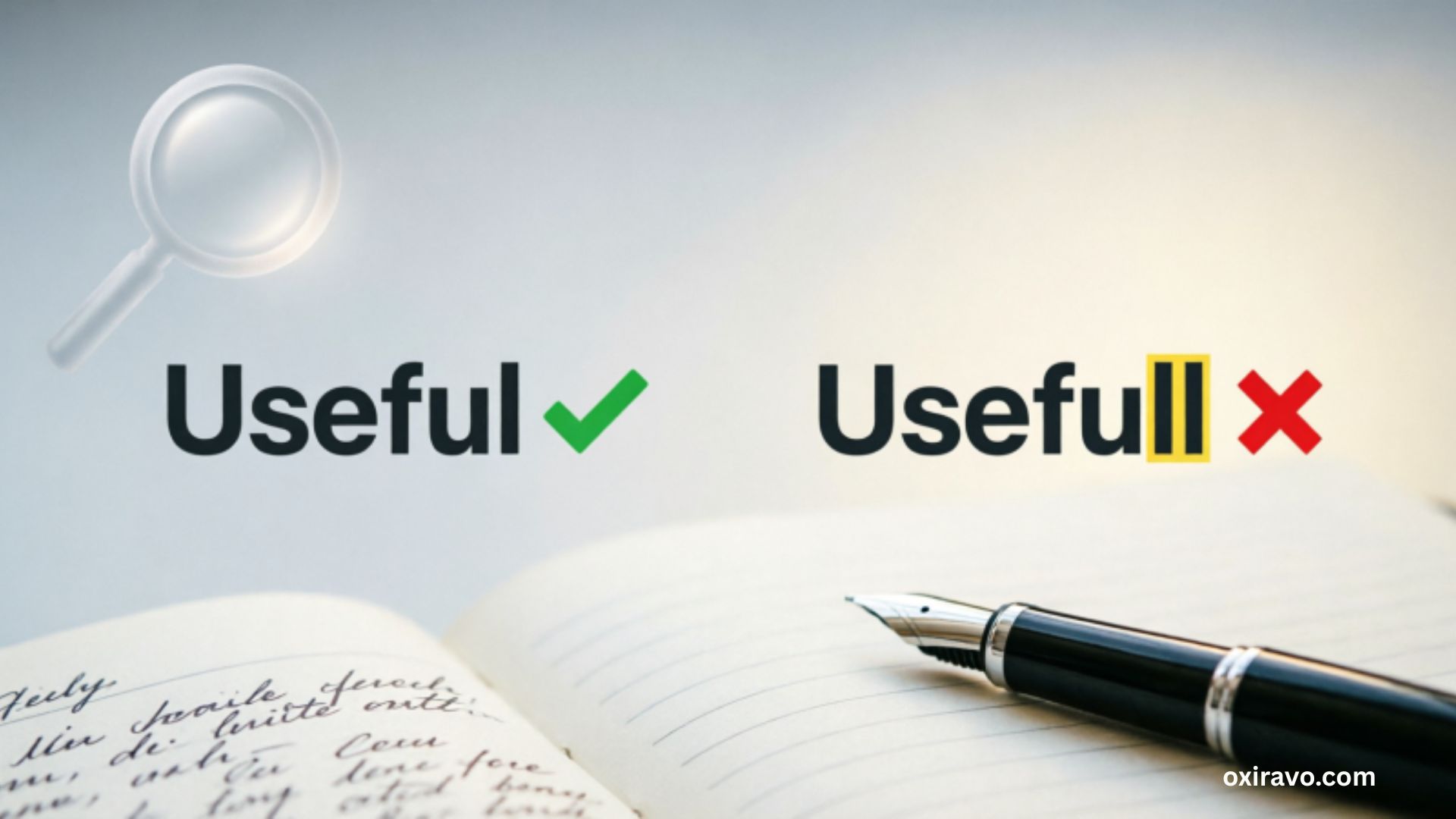
Have you ever paused while typing useful because usefull looked right for a moment? You’re certainly not alone. This spelling confusion appears in school assignments, business emails, social media posts, and even professional documents. Since the word full ends with two l’s, many people naturally assume usefull spelling should follow the same pattern.
However, English doesn’t work that way.
The truth is simple: useful is the only correct spelling, while usefull is incorrect. Once you understand the grammar behind this rule, you’ll never second-guess yourself again.
Throughout this guide, you’ll learn the difference between useful and usefull, discover why is usefull incorrect, explore the grammar rule for useful, and see dozens of practical examples you can use in everyday writing.
Useful vs. Usefull: Quick Answer
If you’re searching for Useful vs. Usefull, here’s the short answer.
| Word | Correct? | Dictionary Accepted? |
|---|---|---|
| Useful | ✅ Yes | Yes |
| Usefull | ❌ No | No |
The correct spelling of useful always contains one “l.”
Therefore, if you’ve wondered is useful or usefull correct, the answer is useful every single time.
Useful Meaning and Definition
Before discussing spelling, let’s understand the useful meaning.
The useful definition is:
Something that helps you, has a practical purpose, or makes a task easier.
In other words, anything that provides value or solves a problem can be described as useful.
The useful meaning in English applies to people, ideas, tools, information, advice, technology, and skills.
For example:
- A dictionary is useful for learning new words.
- This checklist is useful before an interview.
- Good communication is useful in every career.
- Practice is useful when learning a new language.
Because of its flexibility, useful in English is one of the most common adjectives you’ll encounter.
Is Usefull a Real English Word?
Many English learners ask, is usefull a real English word?
No.
Although you may see it online, usefull is not a word recognized by standard English dictionaries. Instead, it is considered one of the most common writing mistakes and common English errors.
Whenever you type usefull, spell check software immediately suggests useful because that’s the accepted spelling.
Useful vs Usefull Difference
At first glance, both words seem reasonable.
That’s exactly why this mistake happens so often.
Here’s the useful vs usefull difference.
| Useful | Usefull |
|---|---|
| Correct spelling | Incorrect spelling |
| Accepted worldwide | Not accepted |
| Appears in dictionaries | Not listed |
| Used in schools and workplaces | Considered a spelling mistake |
Although the two spellings look similar, only useful belongs in correct English usage.
Why Is Usefull Incorrect?
The biggest question people ask is why is usefull incorrect.
The answer comes from the suffix.
English forms many adjectives by adding the suffix -ful to another word.
Notice something interesting.
The suffix itself contains one “l,” not two.
That’s why these words are correct:
- Helpful
- Careful
- Hopeful
- Joyful
- Peaceful
- Powerful
- Beautiful
- Useful
Every one of these words ending in ful follows the same pattern.
Consequently, adding another l creates an incorrect spelling.
The Suffix -Ful Rule Explained
Understanding the suffix -ful rule makes spelling much easier.
The suffix -ful generally means:
- Full of
- Having
- Characterized by
For instance:
| Base Word | New Word | Meaning |
|---|---|---|
| Care | Careful | Full of care |
| Hope | Hopeful | Full of hope |
| Beauty | Beautiful | Full of beauty |
| Power | Powerful | Full of power |
| Use | Useful | Full of use |
This explains why does useful have one l.
More importantly, it also answers why the suffix ful has one l.
English Spelling Rules Behind Useful
Instead of memorizing individual words, it’s smarter to understand English spelling rules.
One important rule says:
When -ful is added as a suffix, it almost always uses only one “l.”
This principle appears throughout English vocabulary.
Examples include:
- Helpful
- Careful
- Faithful
- Thankful
- Joyful
- Graceful
- Successful
- Useful
These are excellent words that follow the -ful spelling rule.
Learning this pattern will dramatically improve your spelling.
How to Spell Useful Correctly
If you’ve ever searched how to spell useful, the process is surprisingly simple.
Start with:
Use
Next, add:
-ful
The result becomes:
Useful
Never write:
❌ Usefull
Always write:
✅ Useful
That’s the proper spelling and the correct English spelling.
One L or Two L in Useful?
Many students ask one l or two l in useful.
The answer never changes.
Useful has one “l.”
A helpful memory trick is to remember the suffix instead of the word full.
Think:
Use + ful
Not:
Use + full
This simple reminder is an easy way to remember useful spelling.
Useful Pronunciation
Interestingly, pronunciation causes part of the confusion.
The useful pronunciation is:
YOOSE-fuhl
Because you can’t hear whether one or two l’s appear, many writers accidentally double the final letter.
As a result, relying only on pronunciation often leads to common spelling mistakes.
Useful Examples in Everyday English
Learning through examples is one of the fastest ways to improve.
Here are several useful examples.
- This planner is useful for managing deadlines.
- Your feedback was useful during the presentation.
- The website offers useful information for beginners.
- Grammar books are useful for improving writing.
- This app became useful while traveling overseas.
- The instructions were useful and easy to follow.
These are excellent examples of useful in sentences.
If someone asks for useful sentence examples, these fit naturally into everyday communication.
Incorrect Usefull Examples
Seeing mistakes helps you avoid repeating them.
Below are several usefull examples that should always be corrected.
❌ This guide is usefull.
✅ This guide is useful.
❌ Her advice was usefull.
✅ Her advice was useful.
❌ The website looks usefull.
✅ The website looks useful.
These examples clearly demonstrate the difference between useful and usefull with examples.
Email Scenario Example
Imagine you’ve attended a professional training session.
Subject: Thank You for Today’s Workshop
Hello Emily,
Thank you for today’s presentation.
I found the resource guide incredibly useful, especially the section covering project planning. Additionally, the checklist will be useful as our team prepares next month’s launch.
I appreciate all the practical advice you shared. It will certainly help us improve our workflow.
Best regards,
Jacob Miller
Notice that every occurrence uses the correct spelling of useful in English.
Classroom Example
During an English lesson, Mrs. Carter reviewed spelling mistakes from a recent quiz.
She noticed several students wrote usefull.
Instead of simply marking the answers wrong, she explained the grammar explanation of useful vs usefull.
“Remember,” she said, “the suffix is -ful, not -full. Once you understand that pattern, words like helpful, careful, and useful become much easier to spell.”
Immediately afterward, the students corrected every mistake.
Sometimes understanding the rule is far more useful than memorizing a list of words.
Workplace Example
A marketing team prepared a report for a client.
One employee wrote:
This dashboard is usefull for tracking campaign performance.
Before sending the report, the editor corrected it.
The final version read:
This dashboard is useful for tracking campaign performance.
Although the client would probably understand both versions, using the correct word choice creates a stronger professional impression.
Why This Mistake Happens So Often
Even experienced writers occasionally hesitate.
Several factors explain why this spelling confusion continues.
The Word “Full” Creates Confusion
Many people naturally think about the word full, which contains two l’s.
Nevertheless, the suffix is different.
Pronunciation Doesn’t Reveal the Spelling
Because useful pronunciation doesn’t emphasize the number of letters, writers often guess incorrectly.
Fast Typing Causes Errors
Typing quickly increases grammar mistakes and spelling errors.
Consequently, proofreading remains essential.
Spell Check Creates Overconfidence
Spell check catches many mistakes. Even so, understanding the rule helps you write accurately when technology isn’t available.
How to Remember the Spelling of Useful
If you’ve wondered how to remember the spelling of useful, try these practical techniques.
- Remember Use + ful.
- Learn other words ending in ful.
- Read quality English every day.
- Practice writing complete sentences.
- Review your mistakes regularly.
- Proofread emails before sending them.
These habits will also help you improve English spelling and reduce common grammar mistakes.
Practical English Writing Tips for Better Spelling
Improving your spelling takes consistent practice rather than memorization. Fortunately, a few simple habits can make a noticeable difference.
Here are several English writing tips that professional editors recommend:
- Proofread your work before submitting it.
- Read books, articles, and newspapers regularly.
- Learn common suffixes instead of memorizing random words.
- Keep a list of words you frequently misspell.
- Read sentences aloud to catch awkward wording.
- Practice writing a few paragraphs every day.
As your confidence grows, you’ll naturally make fewer writing mistakes and develop stronger practical English skills.
Common Spelling Mistakes Similar to Useful
Once you understand the spelling of useful, you’ll recognize the same pattern in many other words. Consequently, you’ll avoid several related errors.
| Incorrect | Correct |
|---|---|
| Usefull | Useful |
| Helpfull | Helpful |
| Carefull | Careful |
| Beautifull | Beautiful |
| Wonderfull | Wonderful |
| Hopefull | Hopeful |
| Faithfull | Faithful |
These examples highlight several spelling mistakes similar to useful. Moreover, they rank among the most frequent common English errors made by students and English learners.
Words That Follow the -Ful Spelling Rule
The spelling rule for ful suffix applies to many familiar adjectives.
Here are some common words that follow the -ful spelling rule.
| Word | Meaning |
|---|---|
| Helpful | Giving help |
| Careful | Showing care |
| Hopeful | Feeling hope |
| Joyful | Full of joy |
| Peaceful | Calm and quiet |
| Faithful | Loyal and dependable |
| Powerful | Having great power |
| Beautiful | Attractive or pleasing |
| Wonderful | Excellent or remarkable |
| Useful | Helpful or practical |
Because each adjective ends with -ful, none of them requires a second “l.” Understanding this grammar rule for useful also improves your overall English grammar guide knowledge.
Useful in a Sentence
Reading complete examples makes grammar easier to remember. Below are several examples showing useful in a sentence.
- The new software is useful for managing customer data.
- Your suggestion was useful during today’s meeting.
- A daily planner is useful for staying organized.
- Online courses are useful for learning new skills.
- The map proved useful while we explored the city.
- Her experience was useful when solving the problem.
- The teacher shared useful advice before the exam.
- A grammar handbook is useful for every writer.
These examples of useful in sentences demonstrate how naturally the word fits into everyday communication.
Is Useful Formal or Informal?
Many writers wonder, is useful formal or informal?
The answer is simple—it works well in both situations.
For example, you can confidently use useful in:
- Business emails
- Academic essays
- Research papers
- Classroom discussions
- Job applications
- Casual conversations
- Text messages
- Blog articles
Because it’s appropriate in almost every context, useful remains one of the most versatile adjectives in English vocabulary.
Useful vs. Usefull for Students
Students frequently lose marks because of avoidable spelling errors. Fortunately, learning the English spelling guide for -ful words eliminates this particular mistake.
Whenever you’re preparing for an exam, remember these points:
- Useful is always correct.
- Usefull is always incorrect.
- The suffix -ful contains one “l.”
- Reading examples strengthens long-term memory.
- Proofreading helps catch small errors before submission.
As a result, you’ll improve both your spelling and your confidence.
Useful vs. Usefull for English Learners
If you’re working to learn English grammar, don’t memorize one word at a time. Instead, focus on patterns.
Once you understand the English suffix ful, you’ll immediately recognize why helpful, careful, hopeful, powerful, and useful all share the same spelling.
That approach saves time while improving your overall correct English spelling.
Furthermore, understanding spelling patterns strengthens reading, writing, and speaking skills at the same time.
How to Avoid Spelling Useful Incorrectly
Many learners ask how to avoid spelling useful incorrectly.
Fortunately, the solution is straightforward.
First, remember that the suffix is -ful, not -full. Next, proofread your work before sending it. Additionally, practice writing complete sentences using new vocabulary. Finally, pay attention to words that follow similar spelling patterns.
These simple habits gradually eliminate grammar mistakes and improve correct English usage.
Common Mistakes with the Word Useful
Although useful is easy to understand, writers still make a few recurring mistakes.
Here are the most common ones.
Adding an Extra “L”
❌ Usefull
✅ Useful
Depending Only on Pronunciation
Since useful pronunciation doesn’t indicate the number of letters, pronunciation alone isn’t enough.
Skipping Proofreading
Even experienced writers make typing errors. Therefore, reviewing your work before publishing remains one of the best forms of spelling correction.
Useful vs. Usefull Meaning and Usage
The phrase useful vs usefull meaning and usage often appears in online searches.
In reality, only useful has an accepted meaning.
Useful means helpful, practical, or beneficial.
By contrast, usefull meaning doesn’t officially exist because usefull is not a word in standard English.
Whenever you intend to describe something that helps or serves a purpose, always choose useful.
Useful vs. Usefull Grammar Rules Explained
Let’s summarize the useful vs usefull grammar rules explained.
| Rule | Correct Form |
|---|---|
| Use the suffix -ful | ✅ Useful |
| Never add another l | ❌ Usefull |
| Follow standard English spelling rules | ✅ Useful |
| Apply the same pattern to similar words | ✅ Helpful, Careful, Beautiful |
Understanding these grammar rules makes spelling much easier than relying on memory alone.
Frequently Asked Questions
Useful vs. Usefull Which Is Correct?
If you’re asking useful vs usefull which is correct, the answer is useful. It is the only accepted spelling in modern English.
Why Is Useful Spelled With One L?
Many people ask why is useful spelled with one l.
The explanation is simple. English uses the suffix -ful, which contains one “l.” Consequently, useful follows the standard rule.
What Is the Correct Spelling of Useful in English?
The correct spelling of useful in English is:
Useful
No dictionary recognizes usefull as a standard English word.
Why Does Useful Have One L?
If you’ve wondered why does useful have one l, remember that -ful is a suffix rather than the standalone word full.
Is Usefull a Real English Word?
No. Usefull is not a word in modern standard English. Instead, dictionaries classify it as a misspelling of useful.
When to Use Useful
Wondering when to use useful?
Use it whenever something is practical, beneficial, or helps accomplish a task.
Examples include tools, advice, information, books, software, lessons, and skills.
Final Thoughts
The debate over Useful vs. Usefull has one clear answer. Useful is the only correct spelling, while usefull is simply a spelling mistake. Although the extra “l” may seem logical because of the word full, English follows a different pattern when using the -ful suffix.
Once you understand the suffix -ful rule, the confusion disappears. Instead of memorizing a single word, you’ll recognize the same pattern in helpful, careful, hopeful, beautiful, powerful, and many other adjectives. Consequently, you’ll make fewer common spelling mistakes, improve your correct English spelling, and write with greater confidence.
Whether you’re a student, a professional, or someone working to learn English grammar, mastering this simple spelling rule will strengthen your writing. More importantly, it helps you communicate clearly in emails, reports, essays, and everyday conversations.
The next time you hesitate between Useful vs. Usefull, remember this simple formula:
Use + ful = Useful
