

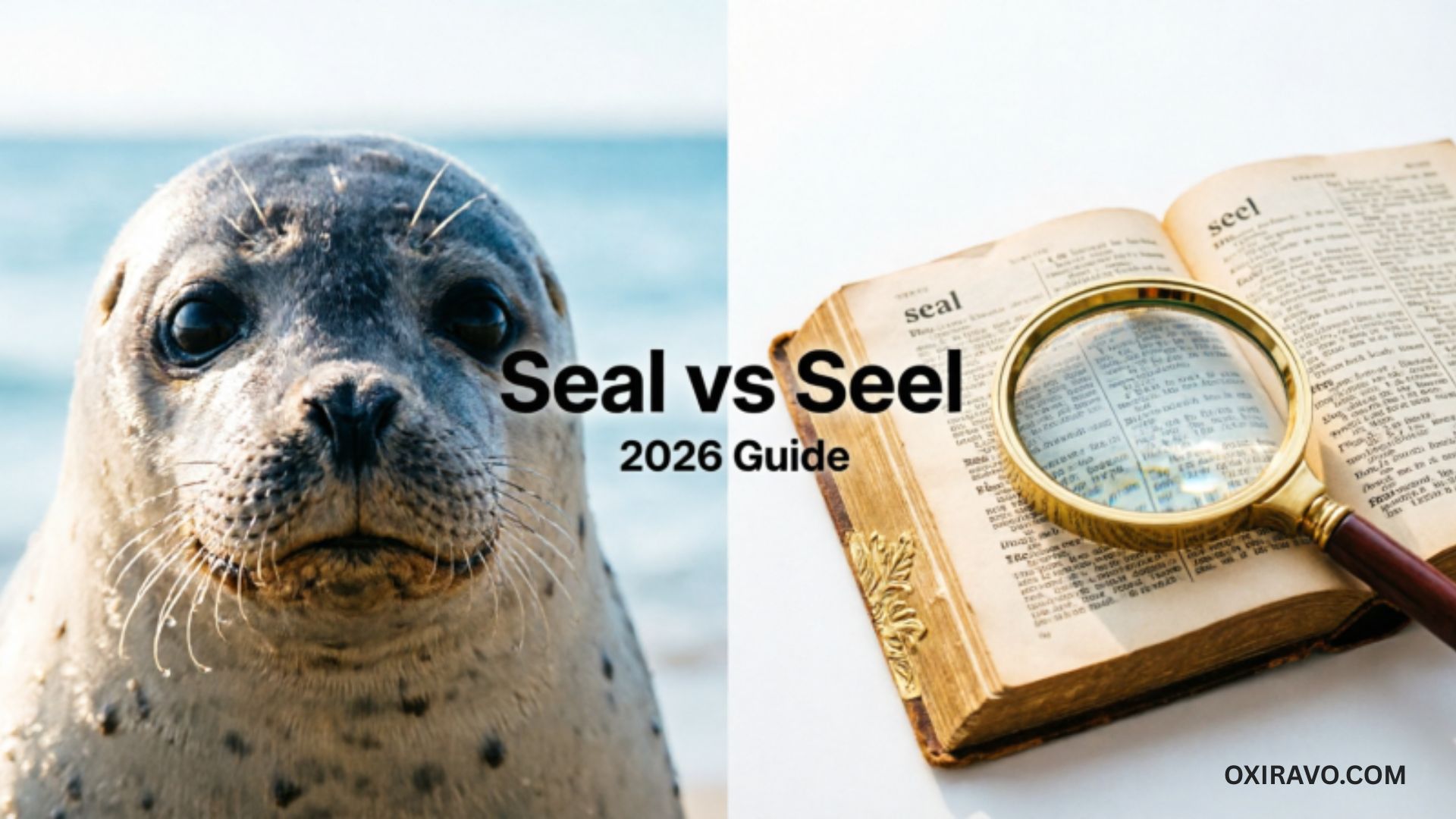
You’re typing an email, and autocorrect flags a word you were sure was right. Or maybe you’ve stumbled across “seel” in an old book and wondered if it’s even real. Either way, you’ve landed in one of English’s quieter traps: Seal vs Seel. These two words look nearly identical, sound the same out loud, and yet mean completely different things — one describes a sleek marine mammal or a wax stamp on a document, the other belongs to the strange, specific world of falconry.
This guide breaks down the seal vs seel difference explained in plain terms, with real-world examples you can actually use. By the end, you’ll know exactly which word belongs where, and you’ll never second-guess yourself again.
Seal vs Seel: The Quick Answer
Here’s the short version before we get into the weeds. Seal is the word you want almost every single time. It’s a noun and a verb with several legitimate meanings: the animal that barks on rocky shores, the wax or embossed mark that authenticates a document, and the act of closing something shut, like an envelope. Seel, on the other hand, is a niche, mostly historical verb tied to falconry. It means to sew a hawk’s eyelids partially closed during training.
If you’re writing a business email, a legal contract, or a story about the ocean, you almost certainly need seal. If you’re not deep in medieval falconry texts or Shakespearean literature, you’ll rarely need seel at all. That’s the seal vs seel quick decision guide in a nutshell — but let’s dig into why this confusion happens and how to avoid it for good.
Why Do People Confuse Seal and Seel?
So why do people confuse seal and seel in the first place? It comes down to sound. English is packed with similar sounding words that trip up even careful writers, and this pair is a textbook case of homophone confusion — or something close to it, since pronunciation can vary slightly by dialect and region.
There’s also a spelling logic trap at play. English has plenty of words where doubling a vowel or swapping “ea” for “ee” changes meaning entirely — think “read” versus “reed,” or “peel” versus “peal.” Someone who’s absorbed that pattern might assume “seel” is just an alternate or more formal spelling of “seal.” It isn’t. This is a classic case of vocabulary confusion born from pattern-matching rather than actual usage.
Add to that the fact that “seel” genuinely exists in English (it’s not a typo waiting to happen, technically), and you get a spelling mistake that feels almost reasonable. That’s exactly why it deserves its own explainer.
Seal Meaning: The Many Faces of One Word
Let’s talk about seal meaning in detail, because this word carries a lot of weight in everyday English.
Marine Mammal
The most familiar sense of seal is the marine mammal — think sleek, whiskered creatures lounging on rocks or diving for fish along coastlines. Seals belong to the pinniped family, and you’ll find them anywhere from Arctic ice floes to California beaches.
Scenario example (casual text message):
Hey Priya, you’ll never guess what I saw at the aquarium today — a baby seal being fed by hand! It barked like a dog. Sending you a video now.
Official Stamp/Document Seal
Seal also refers to an official stamp/document seal — the embossed or wax mark used to authenticate something formal. This usage shows up constantly in legal documents, notarized paperwork, diplomas, and government correspondence.
Scenario example (formal email):
Subject: Notarized Copy Ready for Pickup
Dear Mr. Alvarez,
The requested documents have been notarized and now carry the official seal of the county clerk’s office. Please stop by our office between 9 a.m. and 4 p.m. to collect the paperwork. Bring a valid photo ID for verification.
Best regards, Denise Whitfield Office of Public Records
Envelope/Package Sealing
Then there’s the everyday act of envelope/package sealing — closing something shut so it stays secure during shipping or storage. This is where seal works as a verb rather than a noun, which brings up an important distinction.
Scenario example (workplace memo):
Reminder: Before mailing any client contracts, double-check that you seal each envelope securely and label it with the recipient’s full address. Loose flaps have caused two delivery issues this month already.
Verb vs Noun Usage: How Seal Shifts Roles
One reason seal trips people up in longer sentences is its flexibility. Understanding verb vs noun usage here clears up a lot of confusion.
As a noun, seal refers to the object or mark itself: “The letter bore the king’s seal.” As a verb, it means the action of closing or stamping something: “She sealed the envelope before leaving for the post office.” Same word, two jobs — and English does this constantly, so it’s worth pausing on whenever a sentence feels ambiguous.
Scenario example (customer service reply):
Hi Marcus,
Thanks for reaching out. Your package was properly sealed before shipment, and tracking confirms it left our warehouse intact. If the seal was broken upon arrival, please send us a photo so we can investigate with the carrier.
Warm regards, Customer Support Team
Notice how “sealed” (verb) and “seal” (noun) sit in the same short message without any friction. That’s the versatility of this word at work.
Seel Meaning: A Word Almost Nobody Uses Anymore
Now for the rarer half of this pair. Seel meaning takes us somewhere unexpected: the world of medieval and Renaissance bird training.
Falconry
In falconry, seeling was a technique used to calm a wild hawk or falcon during the early stages of training. Handlers would gently sew the bird’s eyelids partially shut with a fine thread, temporarily limiting its vision so it would stay calm around humans instead of thrashing in panic. It sounds harsh by modern standards, and it is — this practice has long been abandoned in favor of gentler training methods using hoods instead of stitching.
Bird Training Practice
As a bird training practice, seeling was considered standard procedure for centuries. It reflects just how differently people once approached animal handling, and it’s a small window into historical English usage more broadly — a reminder that language often preserves practices we’ve since moved past.
What Does Seel Mean in Falconry, Exactly?
To answer directly: what does seel mean in falconry is simply “to stitch a hawk’s eyelids closed temporarily.” The word itself likely comes from the Old French “ciller,” related to eyelashes and eyelids. Shakespeare even used a form of it in Macbeth, when Lady Macbeth calls on night to “seel” the eye of pity — a poetic nod to blinding or obscuring.
Scenario example (academic email discussing literature):
Subject: Macbeth Annotation Question
Hi Professor Nakamura,
While annotating Act 1 for tomorrow’s discussion, I came across Lady Macbeth’s line about “seeling” the eye of pity. I looked it up and found it’s a falconry term referring to temporarily stitching a hawk’s eyes shut during training. Does this tie into the play’s broader theme of willful blindness? I’d love to discuss this in class.
Thanks, Owen Radcliffe
Archaic/Obsolete Word: Is Seel Still Used Today?
Here’s the honest answer: seel is largely an archaic/obsolete word in modern English. You won’t find it in casual conversation, business writing, or contemporary journalism. It survives mainly in literary analysis, historical texts about falconry, and etymology discussions like this one.
That doesn’t mean it’s fake or wrong — it means its usage window has narrowed dramatically. Language does this constantly; words that were once common slip into specialized or historical corners while their more useful cousins (like seal) stick around and multiply in meaning.
Is Seel a Word? Settling the Debate
So, is seel a word? Yes, technically. Is seel a real word in English? Also yes — it appears in unabridged dictionaries and historical falconry texts. But here’s the catch: for the overwhelming majority of writers, in the overwhelming majority of contexts, you won’t ever need it.
If you’re drafting a work email, texting a friend, writing a product description, or filling out a form, “seel” has no place there. Reach for it only if you’re specifically discussing falconry history or annotating older literature.
Correct Spelling of Seal: Getting It Right Every Time
Let’s nail down the correct spelling of seal so this never trips you up again. It’s S-E-A-L — no double vowels, no swapped letters. Think of it this way: seal rhymes with “meal,” “deal,” and “heal,” and all of those follow the same “ea” pattern. If you can spell “meal,” you can spell “seal.”
How to spell seal correctly in a sentence comes down to remembering that single, consistent pattern rather than second-guessing yourself mid-sentence. A quick trick: picture a wax seal pressed onto a royal letter — the image alone can anchor the spelling in your memory.
Correct Usage of Seal in a Sentence
Let’s look at a few examples of correct usage of seal in a sentence across different contexts, since seeing the word in action beats memorizing a rule any day.
Scenario example (wedding invitation wording):
Please join us as we seal our vows with a promise to love and support each other through every season of life.
Scenario example (business proposal closing line):
We’re confident this partnership will seal our position as the leading supplier in the region.
Scenario example (casual conversation, text to a friend):
Can you grab tape from the drawer? I need to seal this box before the movers get here at noon.
Each of these sentences uses seal correctly, whether as a verb of closing, a verb of confirming, or in a figurative sense. Versatility is exactly why this word shows up so often across writing styles.
Seal Vs Seel Spelling Mistake: How to Catch It Before You Hit Send
A seal vs seel spelling mistake usually happens in a rush — you’re typing quickly, your brain autocorrects the vowel pattern without you noticing, and suddenly you’ve written something that looks almost right but isn’t. Here’s how to catch it:
- Read your sentence back slowly. If the word refers to an animal, a stamp, or closing something, it should be seal.
- Ask yourself if falconry is involved. If not, seel almost certainly doesn’t belong.
- Trust your spell-checker, but don’t rely on it blindly.
Spell-Checker Recognition
This brings up an interesting technical wrinkle: spell-checker recognition. Because “seel” is a legitimate dictionary word, most spell-checkers won’t flag it as an error even when you meant to type “seal.” This is precisely the kind of mistake that slips past automated tools — it’s a real word, just the wrong one for your sentence. When both words are valid English, spell-checkers check spelling, not meaning, so the responsibility falls back on you as the writer.
When to Use Seal Instead of Seel
Let’s make this dead simple. When to use seal instead of seel comes down to a single question: are you talking about an animal, a stamp, or closing something? If yes, use seal. That covers roughly 99.9% of writing situations you’ll ever encounter.
Can seel be used instead of seal? No — not in modern English, and not without confusing your reader. The two words aren’t interchangeable synonyms; they’re unrelated concepts that happen to share a similar sound. Swapping one for the other isn’t a stylistic choice, it’s simply incorrect.
Seal Meaning Animal Stamp Closure: A Quick Recap Table
Since seal carries three major meanings, here’s a table to keep them straight — seal meaning animal stamp closure, all in one word.
| Context | Meaning | Example |
|---|---|---|
| Nature/wildlife | Marine mammal | “The seal dove beneath the waves.” |
| Legal/formal | Official stamp or mark | “The document bears the notary’s seal.” |
| Everyday action | Closing something shut | “Seal the envelope before mailing it.” |
Seel Meaning Historical Bird Training: A Quick Recap
And for comparison, seel meaning historical bird training sums up its entire modern relevance in one line: it’s a term describing the now-abandoned falconry practice of temporarily stitching a hawk’s eyelids shut during early training. That’s it — no other common usage exists today.
Grammar and Spelling Guide: Broader Lessons From This Pair
This isn’t just about two obscure words — it’s a useful case study for grammar and spelling guide purposes more broadly. English is full of commonly confused words that sound alike but diverge wildly in meaning: “affect” and “effect,” “compliment” and “complement,” “stationary” and “stationery.” The seal-seel pair is just a less famous member of that family.
Whenever you’re unsure, ask three questions:
- Does the sentence involve a well-known, common concept, or something obscure and specialized?
- Would a general audience recognize the word I’m about to use?
- Am I choosing this spelling out of habit, or because I’ve actually confirmed it’s correct?
Word usage rules like these apply far beyond this one word pair. They’re a mental checklist worth keeping for any tricky homophone that crosses your path.
English Spelling Mistakes: Why This Kind of Error Persists
English spelling mistakes involving obscure-but-real words are some of the hardest to catch, precisely because nothing looks broken on the surface. A red squiggly line under a typo is easy to spot. A perfectly spelled wrong word is not. That’s the sneaky part of English language mistakes like seal versus seel — they hide in plain sight, dressed up as correct English.
The fix isn’t complicated, though: build the habit of pausing on words that feel slightly unfamiliar, and when in doubt, look it up. Thirty seconds of doubt beats an email that reads strangely to your recipient.
Final Thoughts: Seal vs Seel, Settled for Good
At this point, you’ve got everything you need to navigate Seal vs Seel with total confidence. Seal is your everyday word — animal, stamp, closure, and everything in between. Seel belongs to a narrow historical corner of English tied to falconry, useful mainly for literature discussions or historical curiosity.
Next time you catch yourself hesitating over which one to type, remember this: if you’re not discussing medieval hawk training, you want seal. Every time.
